


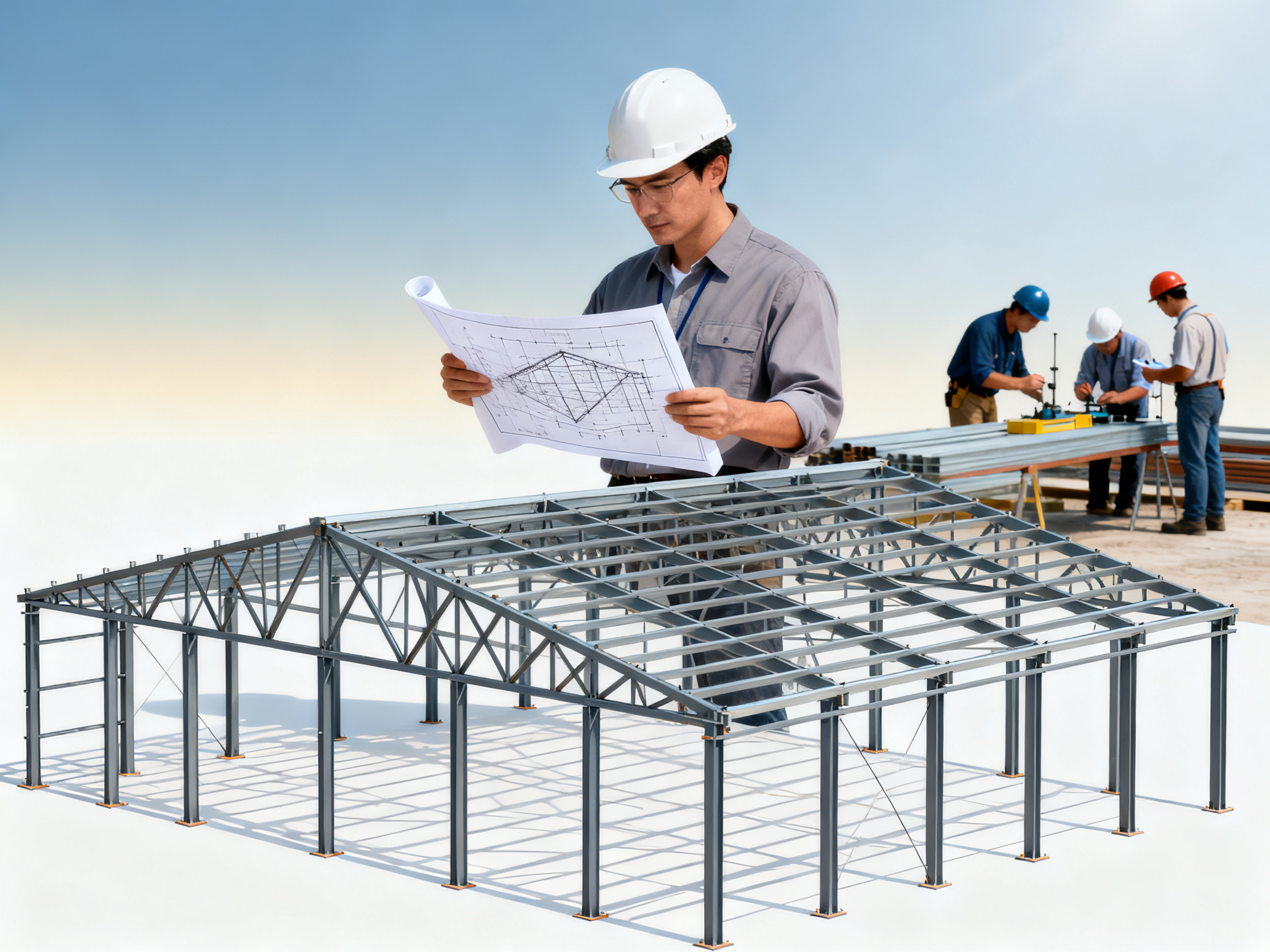
Steel Warehouse Construction Safety Guidelines for Earthquake-Prone Zones
Constructing steel warehouses in earthquake-prone regions requires adherence to specialized safety protocols that balance structural integrity with seismic resilience. Key considerations include base isolation systems, moment-resisting frames, and ductile detailing to absorb seismic energy. The design must comply with local seismic codes (e.g., IBC, Eurocode 8) while accounting for soil liquefaction risks and aftershock scenarios. Proper bracing configurations and connection designs are critical to prevent progressive collapse. Material selection should prioritize high-grade steel with certified toughness properties, and all welds must undergo rigorous non-destructive testing.
Core Seismic Design Principles
Structural Configuration
Warehouses in seismic zones require low-center-of-gravity designs with symmetrical layouts to minimize torsional effects. Diagonal bracing or shear walls should distribute lateral forces evenly across the structure. Roof systems must allow for diaphragm action without creating stress concentrations.
Material Specifications
ASTM A992 steel is recommended for primary members due to its proven yield strength (50-65 ksi) and elongation properties. All materials require mill test certificates verifying Charpy V-notch impact values at the project's lowest anticipated service temperature.
Connection Engineering
Moment connections should use slip-critical bolted joints or complete joint penetration welds. Gusset plates in braced frames must accommodate expected deformations without buckling. Base plates require anchor bolts designed for 130% of calculated uplift forces.
Implementation Considerations
Site-Specific Factors
Soil reports must determine the seismic design category (SDC) and potential liquefaction zones. In SDC D-F areas, deep foundations with pile caps may be necessary. Topographic effects like slope instability require separate geotechnical analysis.
Quality Control Protocols
Fabrication facilities should implement EN 1090-2 execution class requirements, with particular attention to weld procedure qualifications. Third-party inspection of critical connections is advisable for projects in high-seismic zones.
Industry Practices for Seismic-Resistant Warehouses
Most reputable fabricators employ one of three approaches for seismic zones: concentrically braced frames (CBFs) for cost-sensitive projects, eccentrically braced frames (EBFs) for balanced performance, or buckling-restrained braced frames (BRBFs) for maximum energy dissipation. The choice depends on project budget, seismic activity level, and operational continuity requirements.
If target users require warehouses with rapid post-earthquake operational recovery, then solutions incorporating BRBF technology and modular damage-control elements typically prove more effective. For projects with strict budget constraints but moderate seismic risk, properly engineered CBF systems with rigorous quality control may suffice.
Key Evaluation Points
- Verify the fabricator's experience with seismic detailing through project references in similar zones
- Confirm material certifications meet both strength and toughness requirements for the seismic category
- Review the connection design philosophy against established performance-based engineering principles
- Assess quality control documentation procedures for traceability of critical components
- Evaluate transportation and erection plans for maintaining structural integrity before final connections
For due diligence, request sample calculation reports for a previous seismic project demonstrating the engineer's approach to drift limits, connection rotations, and capacity design principles. Reputable providers should readily share anonymized examples.
We are more than happy to serve you here. If you have any question, please feel free to contact us.